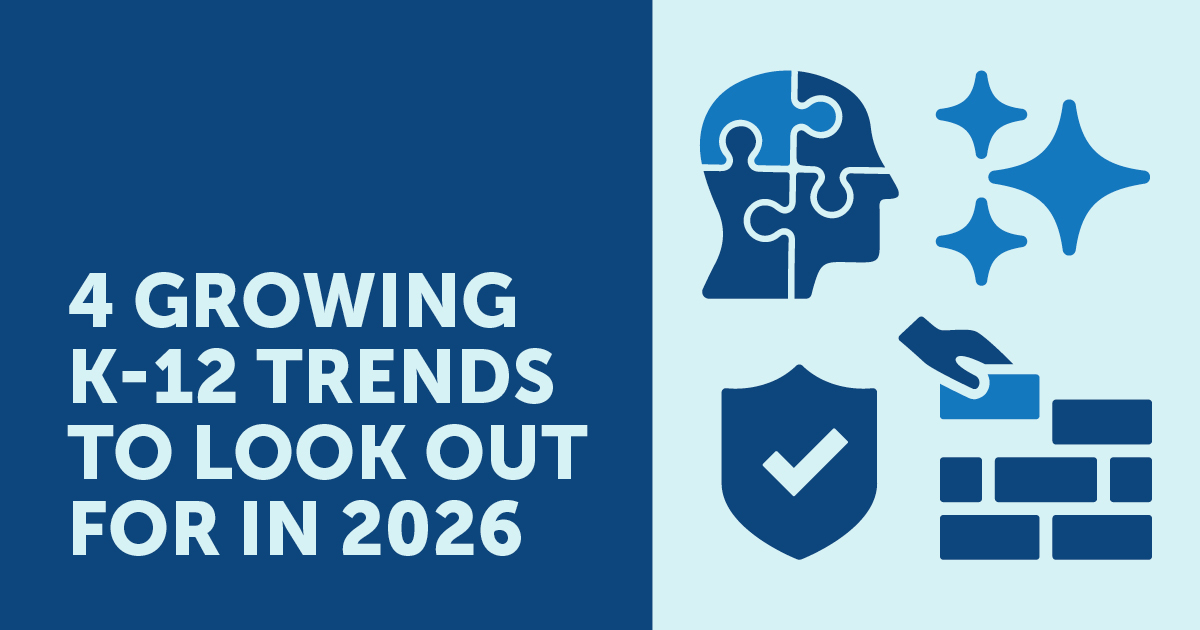
The educational industry is always evolving with new teaching techniques and EdTech and seems to be rapidly accelerating faster than ever before. From Artificial Intelligence breaking into personalized learning, to data protection in the form of phone bans and more, the educational industry is changing in 2026.
Here are some growing K-12 trends to look out for within the next year:
Artificial Intelligence
As AI continues to expand exponentially, states are working on guidance, policies, and professional development efforts to combat misuse. AI can be very beneficial as an efficient and personalization tool but has been seen to be abused as a replacement for learning. Both teachers and students need to be taught the right ways to use AI to their benefit, instead of it being a replacement for ones own learning.
As more platforms integrate AI technology, K-12 leaders will need to account for the impact and accessibility of these platforms in their student online safety strategies. The rise in AI has highlighted the need for more teacher training and advanced cybersecurity measures to mitigate risks posed by it.
Digital Citizenship & Safety
While device bans continue to be implemented or debated in over 30 states, others are focused on promoting responsible use and digital safety. With the expansion of AI in schools, data security concerns have grown, making it easier for schools to receive data attacks. In 2026, stronger data protection policies are expected to be in place at both district and federal levels.
Teachers will need to understand how to safeguard student information, use approved platforms, and model responsible digital citizenship. This will be part of every educator’s professional duty, not just an administrative requirement.
AR/VR Immersion
Using immersive tech, such as AR and VR, for experiential learning shifts focuses to skills-based micro-credentials over just grades, and adopting hybrid models with more project-based, adaptive assessments, all while focusing on sustainability and accessibility. Experiments can be carried out in virtual labs without the cost or risk of working with expensive equipment.
Research has repeatedly shown that adding rewards, competition, and the potential to iteratively improves performance, and helps with the ability to absorb and retain knowledge.
Human-Centric Skills
With AI and innovative technology dominating the classroom, there becomes a lack of person-to-person interactions where schools need to fill the gaps. Students still need to learn interpersonal relationships, lead groups, empathize, collaborate, utilize human creativity, and more that can only be learned through their peers and from their teachers.
Human-centric skills improve learning retention, personal growth, and successful transitions to future careers and life. Working with peers also helps relate more to lessons and their classmates while exposing students to real-world scenarios with diverse perspectives and ideas.
What trend are you looking forward to seeing expand within the next year? Let us know in the comments!
Resources:
 VARconnection